“How GPS Works”
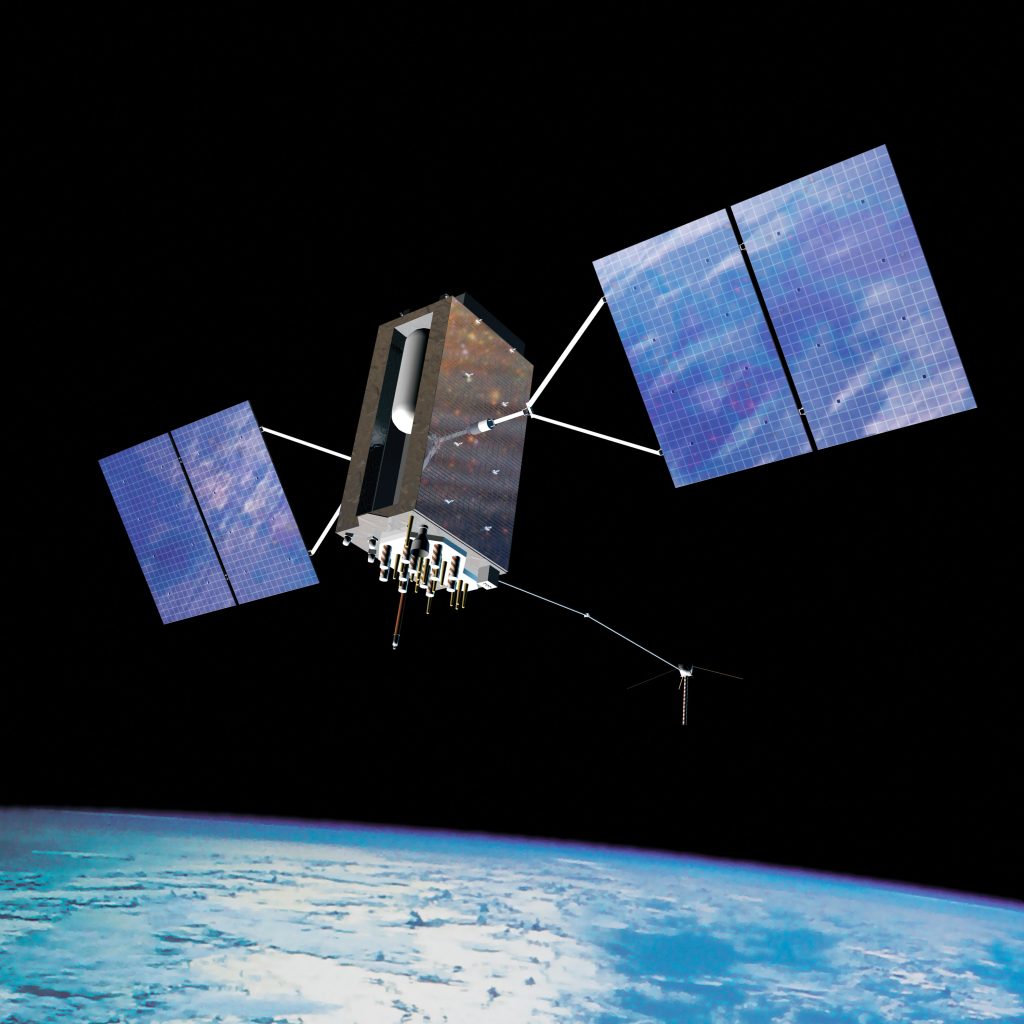
Photo by US Government: Released in the Public Domain: Image of a GPS III satellite.
By Scott Hamilton
I came across something interesting this last week that talked about how the GPS in your cell phone knows your location. If you are like most people, you get the idea that the fact that your phone knows your location also means that, by default, the satellite and the cell phone provider also know your location. This is not always the case. You must share your location information with them in order for them to know your location, unfortunately it is the default setting on most cell phones to share the location. The great news is that it is not a feature of GPS in general, but a feature of the phone and service provider. What this means is that if you want to use a GPS without being tracked, it is entirely possible, with the right equipment.
I used to think that the GPS communicated with satellites in order to determine the exact location, but learned just recently that there is no communication from the GPS to the satellite, that all the communication is one way. I also learned that GPS satellites are much simpler than one would think. A GPS satellite is just a very accurate clock and radio transmitter. All the satellite does is repeatedly send out a message that roughly says, “I am here, and the current time is ___”.
Meanwhile on the ground your GPS is listening for signals from the various GPS satellites. The GPS knows the exact time, and from that exact time it can determine how long it took the signal to travel from the satellite to the GPS. From this time, since the signal travels at a known speed (the speed of light), we know how far away we are from that GPS satellite. This gives us the radius of a sphere surrounding the satellite. We also know that we are located on another sphere, the earth. From some simple rules of geometry, we know that when two spheres intersect it creates a circle. So, with a single GPS satellite, we can know very quickly that we are within a certain circle on the ground.
The GPS then does the same thing with the signal from a second satellite, which gives us another sphere, which creates a second circle which we must be inside. We are most likely on one of the two points where these circles intersect. We can eliminate one of them because we hopefully know the general location, i.e. the country or state where we are located. The crazy part is that if we add a third satellite signal, we don’t even need to know that, because we get narrowed down to a triangle, which, with current technology, is about five feet on each side. So that makes it fairly simple if your GPS knows the exact time. But what if it doesn’t?
Here is where the technology behind the GPS gets really interesting. If we don’t know the exact time, the GPS will use the time from one of the satellites, with a guess on how long it took the signal to reach you. It uses this guess as the exact time, and once it calculates your location based on this time, it will find that if the guess on the time was wrong, you will either be positioned in the air or underground. When it discovers this discrepancy, it will adjust the time offset and try again until your position is on the surface. This creates an interesting side effect that, while trying to calculate your exact position, you wind up synchronizing your clock to a very high precision. In fact, sometimes we use GPS satellites to set the clocks on critical computer systems that don’t really care where they are, but need an accurate time.
Of course the above is explained in a much simpler way than the real math taking place inside the GPS, because there are other factors that come into play, like signal interference as we are using light travelling over extreme distances which can be effected by Newton’s law of general relativity. But those are very deep topics for physicists and GPS designers to worry about; for us the explanation is sufficient to understand that we are really just listening to a bunch of clocks telling us where they are and what time it is. Until next week, stay safe and learn something new.
Scott Hamilton is an Expert in Emerging Technologies at ATOS and can be reached with questions and comments via email to shamilton@techshepherd.org or through his website at https://www.techshepherd.org.