“Ancient Numbers”
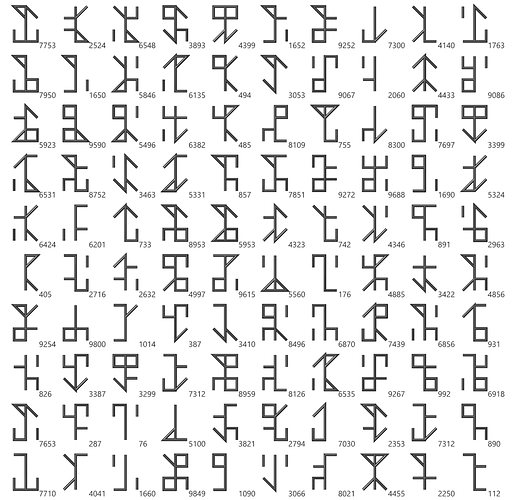
Photo from https://discourse.mcneel.com/t/cistercian-numerals/122742 sample output from McNeel's program to generate Cisterian numbers.
I came across a very interesting article this week that was talking about an ancient number system developed by a Cistercian monastary.They primarily used the number system for numbering pages or writing dates in as little space as possible. The Cistercian number system was developed in the 12th century and allowed one to write any number between zero and 9,999 in a single symbol. Every number started with zero as a single vertical line, each digit was given a corner off of this central line. The top-right corner was the ones place, the top-left was the tens, the bottom right was the hundreds and the bottom-left was the thousands. They made nine different strokes to represent the digits in each corner.
This number system was based on a shorthand system introduced by John of Bashingstoke, the archdeacon of Lecester. This number system gave a much shorter method of writing long numbers in comparison to the Roman numeral system, but was quickly replaced by the Arabic numerals which made calculation easier and didn’t take much more space than the Cistercian system. The Cistercian system survived only in ciphers and secret codes in Masonic texts for centuries.
Reading about Cistercian systems got me thinking about other ancient number systems and wondering if maybe there was one that would be more efficient in modern technologies, and I actually came across a few that might work better in conversion to binary, used in all modern computing systems. The Sumerians used a number system in 3100 BCE which was based on two core numbers, 10 and 60. To understand why it could work better, you need to understand a lot about number systems and their bases. A base is the number or numbers that represent the maximum number of digits in a place value. For example binary has a base of two, so each place value can hold only two values (1, 0). Each place value doubles the place value of the previous digit, so they are (1, 2, 4, 8, 16, etc). The decimal system which you are all most familiar with has ten digits in each place value and the place values multiply by ten (1, 10, 100, 1000, etc).
There are number systems with two bases; the most famous of these is the Roman numeral system which has a subbase of five and a base of tens, so each digit is organized by fives (V=5, L=50, D=500) and tens (X=10, C=100, M=1,000). The Sumerian system is also a two-base system organized by tens and sixties. While it may seem strange to us, they basically counted as we would until they reached 60 and then instead of going to 61, they would write it as 120 minus 59. So what exactly is convenient about a base-60 number system? It really has to do with the system’s high divisibility, making it easier to represent fractions and ratios, and reducing fractions is a lot easier and more accurate than in the decimal system. It was an incredibly advanced number system for its timeframe but is just as complex as the decimal system to represent in binary, because binary works best for number systems with a perfect power of two-base.
Most other ancient number systems were based on a decimal system, meaning they were nearly all base-10 number systems, that is, until the invention of computers, when there was a shift to Octal (base-8). However, if you look deeper into the history you find that China was the first to represent an Octal number system using the eight bagua or trigrams of the I Ching. In 1703 Gottfried Wilhelm Leibniz made a connection between trigrams, hexagrams and binary numbers. It was not until sometime in the 1950s that hexadecimal systems became more popular with early 4- and 8-bit computer systems. The importance of the hexadecimal system is linked tightly to these early computer architectures because one could represent a full memory address in a 4-bit system with a single hexadecimal digit instead of four binary digits and the 8-bit systems could be written as two digits instead of eight.
So, I guess from a quick look at the history of numbers it seems the future of numbers is likely to either remain hexadecimal or perhaps something more advanced; as computer address space is now at 64 and 128-bits, even hexidecimal is getting fairly long to represent computer memory address spaces. However to get to the next easily delimiter of a digit representing 16-bits we would need a base-65,536 number system, which is extremely impractical; good luck representing 65,536 digits as unique symbols. So it seems we are stuck with hexadecimal for the long haul. Except maybe for applications within AI workspaces, as it is highly possible for an AI to remember a number notation with an extremely large base.
It seems like maybe sometime around 1700 AD there were already some thoughts about computers based off of a simplified number system, because we have always found it easier to think of things in two states, on/off, dark/light, good/evil. It only seems logical that when we try to design intelligent systems, we must simplify them to the basics of binary, but sadly life is much more complicated and nothing is ever as simple as two states. Which leads me to believe that until we can grasp the deeper complexity, we will never truly reach the ability to create artificial general intelligence, because our computer will always be binary in nature, limiting AI to simplified states of being. Until next week stay safe and learn something new.
Scott Hamilton is an Expert in Emerging Technologies at ATOS and can be reached with questions and comments via email to shamilton@techshepherd.org or through his website at https://www.techshepherd.org.