“Happy Birthday Floppy Disk”
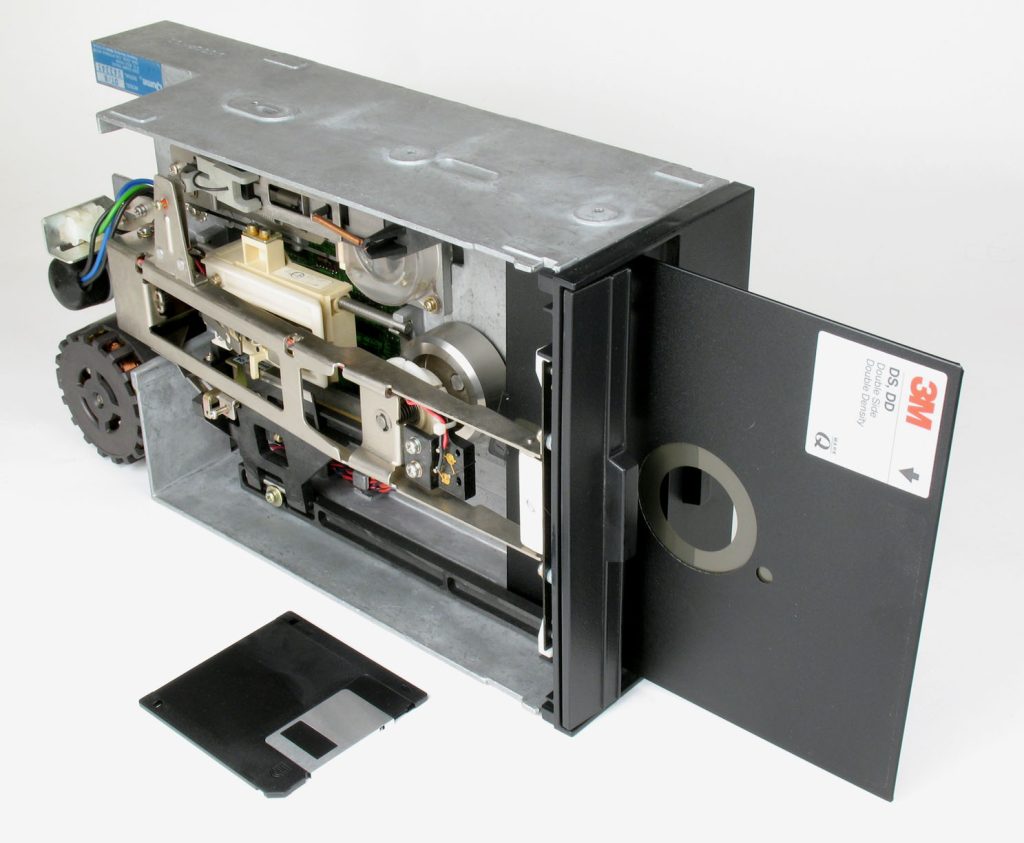
Qume Data Trak 8 inch floppy disk drive with diskektte. Circa 1979, 1.2 MB. Photo by Michael Holley, July 2007
Continuing on the trend of classic computing topics, I learned that 54 years ago last week, June 5, 1972, two engineers at IBM were granted patent number 3668658A for a “magnetic record disk cover” that described a rotary magnetic medium housed in a protective cover that cleaned and protected the surface. Many of you may remember the hard plastic disks that were three and a half inches square, you know, the ones that look like someone 3-D printed the Save icon, and may have wondered why they were called floppy disks. Well, let’s just say it all started in 1972 with the first floppy disks.
These early floppy disks were eight inches in diameter and were very floppy; think of a giant flat sheet of material about the same thickness of a sheet of printer paper, enclosed in a thin plastic sleeve. These monster sized floppy disks were designed to hold 80 kilobytes of data, which was actually quite a lot for the time period; most computers were 8-bit and limited to 128 kilobytes of total memory space.
The patent date of 54-years ago was nowhere close to the beginning of the floppy disk. You see the design process started in 1967 as part of IBM’s Project Minnow. They had the idea of this removable Mylar disk coated with magnetic material that could be inserted through a slot into a reader. It would allow computer data to be portable and removable. The idea was to replace the tapes or punched cards used to transport data previously. The goal was to have a price point of under $200 for the device and a cost of less than $5 for the media. IBM launched the product in 1971 a year before the patent was approved.
The 8-inch floppy was advertised as holding the same amount of data as 3,000 punched cards, which fit well in the era in which it was introduced. It was 1977 when the Apple II was launched, and it came with a 5.25-inch floppy disk riding on a license of the IBM patent, but carrying a patent of its own. Steve Wozniak developed a new recording scheme for the floppy that increased its capacity from 80 kilobytes on the ungangly 8-inch disk to 140 kilobytes on the smaller media. A year later Tandon introduced a double-sided drive offering storage capacities of 360 kilobytes and the capacity just kept growing from there.
By 1984, IBM would come back into the lead with a technology that allowed for 1.2 megabytes of data storage on these 5.25 inch disks; ironically the same year Apple released a new 3.5-inch floppy disk mechanism co-designed with Sony. In 1986 IBM improved on Sony’s design and this is where we met the top capacity of the standard floppy disk technology, coming in at 1.44 megabytes. These disks were popular through the early 2000s as the main media used to transport software and computer files.
Floppy disks had an amazing run as far as computer technology goes, with sales topping five billion disks a year. The next shocking thing to happen around the floppy disk was in 1998, when Apple once again left technology journalists surprised when they equipped the new iMac with a built-in floppy drive. Everyone else used them as an externally connected device. What you may find really crazy is that floppy disks are still widely used today in very high security systems and by classic computing enthusiasts.
If you begin to dig deeper into this technology, you may be surprised to discover that several fairly large organizations still depend on the floppy disk for daily operations, for example the San Francisco Muni Metro system, the New Jersey state prison system, and the German Navy. The information for this article came from facts in an article at Tom’s Hardware and I really enjoyed their read, but wanted to add my own commentary. I can still remember when I bought my first computer that contained a hard drive, which is the internal, large capacity storage device. The hard drive in my computer was only a 10 megabyte hard drive, but it was back in the day when a floppy disk held 360 kilobytes of data. I remember saying I would never use all that space. I copied every floppy I owned to the hard disk and only used 25% of the storage. Let’s just say it was less than a year later when I filled it up and started moving files to the 1.44 megabyte floppies to keep more data. Today I have three external hard drives with a total capacity of 12 terabytes that are all full. This is the same as 12,000 of my original 10 megabyte drives I thought I would never fill up. I have learned that people will hoard data if given the space, and it is probably the reason Google stopped allowing unlimited space in g-mail accounts. They knew we cannot control ourselves without limits. Until next week stay safe and learn something new.
Scott Hamilton is an Expert in Emerging Technologies at ATOS and can be reached with questions and comments via email to shamilton@techshepherd.org or through his website at https://www.techshepherd.org.