“Erasable Ink”
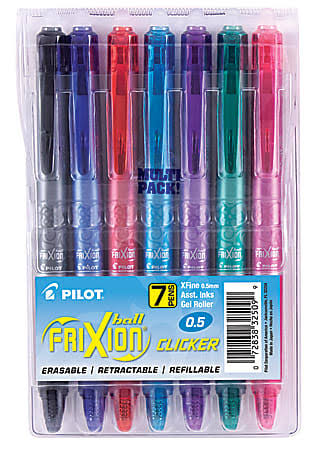
Photo from Amazon.com: FirXion Pens multicolor pack.
This week is going to be a little different as it is touching on a technology that I have never even considered looking at before, but I saw a short video about it and found it fascinating. I hope you will as well. Have you ever been in the middle of writing something important down on a piece of paper in ink and made a mistake? What are you going to do about it? If the paper is white, you could cover up the mistake with white-out, but what if it is colored paper? They do make ink erasers, which is really just a fancy name for a block of sandpaper. All they do is remove the top layer of paper and most of the time make a hole in place of your mistake. This was the exact dilemma for thousands of students over the years, especially in Europe where all school work was required to be done in ink.
Well, I know anyone that had a child at the Licking Rodeo has likely seen a bottle of disappearing ink; my kids came home with at least four bottles and it was fun while it lasted, but how exactly does that disappearing ink work? I used to think it evaporated, but as it turns out that is not the case at all. It is a special ink that is UV reactive and turns clear when exposed to ultra-violet light, i.e., the sun. Well as it turns out modern erasable ink works in a similar manner. Among the most popular erasable pens are the Pilot FriXion, which uses a patented ink from Pilot which is heat sensitive; it doesn’t really erase at all.
Older types of erasable pens like the Paper Mate Eraser Mate, which I used a lot in high school in the late 1980s, used a rubber-cement based ink that would not soak into the paper, but stayed stuck to the surface. The eraser on the Eraser Mate lifted the rubber cement off the paper, so this was truly erasable, but not very well. I can remember it leaving marks and streaks behind on the paper and you could always tell something had been erased. These new FriXion pens are nothing like the Eraser Mate; when you erase their marks they completely disappear, or at least they seem to completely disappear from the page. However, I learned just today that they are not actually erased, but chemically changed by the heat caused from the friction of the eraser. Every mark is still there, it is just completely transparent.
You won’t find this information on the package for pens, but it probably really should be there somewhere, because there are two main issues with an ink that is temperature sensitive that you might need to know if you plan to use the FriXion erasable pens. The first is that the ink changes with heat. I know it has happened to you with a receipt from a gas pump in the heat of summer. You leave it in your wallet on the dash and come back to a black piece of paper. You have lost all the information on the receipt. The same thing can happen with the Frixion ink. I think it has actually happened to me with a notebook left on the dash of the car. I knew I had written down an important phone number on the paper earlier in the day and I could not find it anywhere in the car, but of course I have no proof.
The second problem is that if the ink can disappear when it is heated, can it reappear when it is cooled back down? I thought about the invisible ink that we used to make when I was in junior high. We wrote notes to each other in lemon juice on white paper. When you held the paper over an old incandescent light bulb, the heat from the bulb would “burn” the lemon juice and the writing would appear. I wondered if there was any way to make the FriXion ink reappear, since it was admittedly not really erased but just turned transparent. Is there any way to get it back?
As it turns out the FriXion ink can reappear if exposed to freezing temperatures, which means it is really an invisible ink, not an erasable ink. It just uses a different trick to make it reappear. You get it really cold instead of really hot, and unlike the lemon invisible ink, you can heat this back up and make it disappear again. This gave me a really crazy idea about writing a note on a notepad with a heating element in it and making a message that will self-destruct, and it is something I would really like to try. The problem is the temperatures are a lot hotter than you would think could be generated by rubbing an eraser across paper; it disappears at 140 degrees. However, making the ink reappear is quite possible with a deep freeze as it only requires a temperature below 14 degrees to magically reappear. So you might say just like I have about the internet, if you don’t want something to be read, don’t put it online or write it in ink, even erasable ink. It is also important to note that you probably don’t want to use it on important legal documents; you would not want the signature to disappear on your checks.
Until next week, stay safe and learn something new.
Scott Hamilton is an Expert in Emerging Technologies at ATOS and can be reached with questions and comments via email to shamilton@techshepherd.org or through his website at https://www.techshepherd.org.